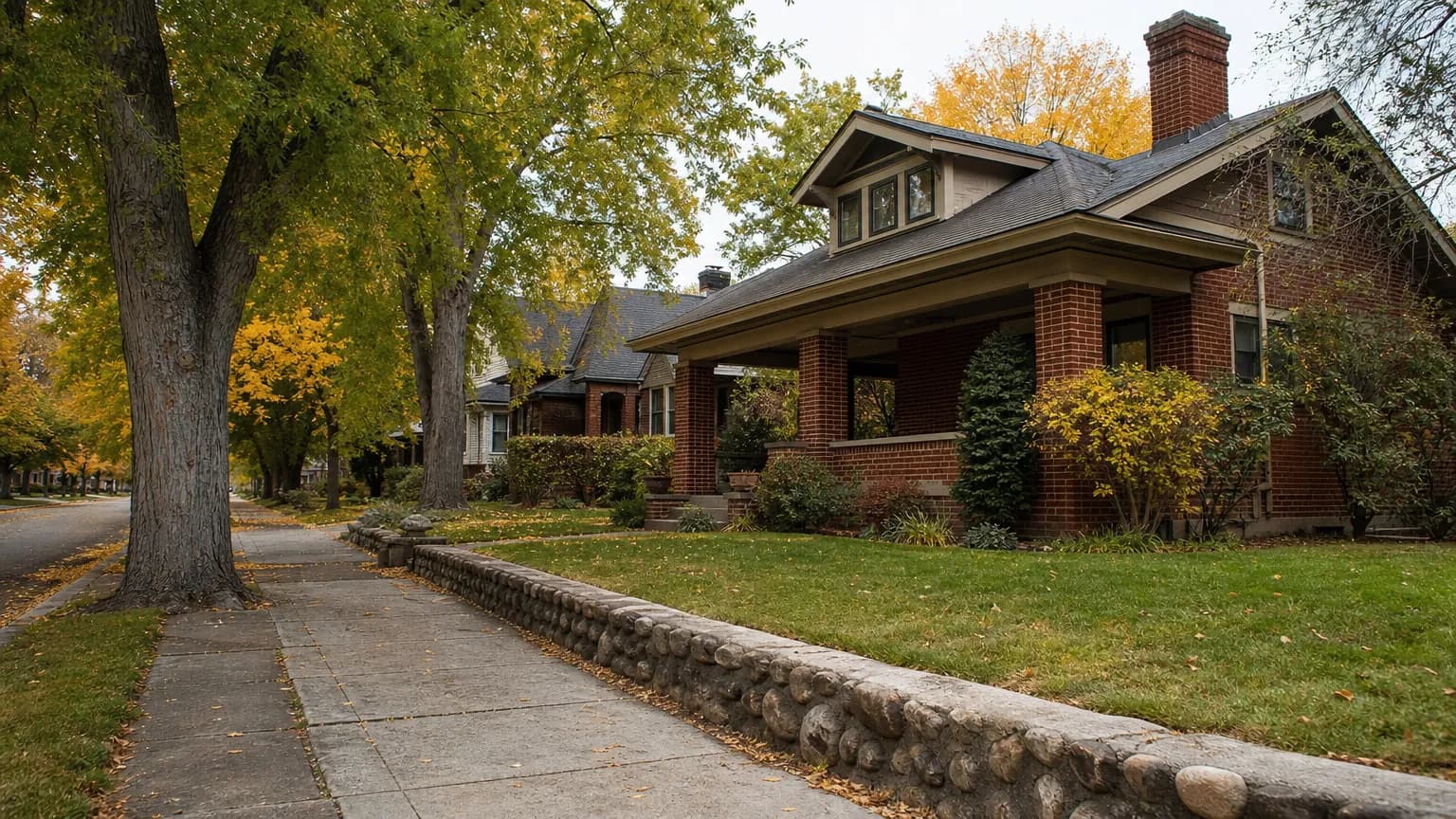
Old houses, old concrete
The North End is the tree-lined area north of State Street, below the foothills. Harrison Boulevard, named for President Benjamin Harrison, who signed Idaho into the Union in 1890, is lined with mansions built after 1900. Hyde Park, a historic community of about 200 homes, sits near Camel's Back Park, where the foothills trails begin. The median home in the area dates to about 1936.
Concrete from those decades is often thin, unreinforced and long past its life. Typical requests: new front steps, replaced walkways, driveway replacement on narrow strips running back to a detached garage, and repair on basement stairs and areaways.
Street trees and roots
Mature trees are what the North End is known for, and their roots lift walks and driveways. Replacing a lifted panel without dealing with the root just sets up the next lift; cutting large roots can harm the tree. Trees along the street may belong to the city, so check before anyone cuts. Options include rerouting a walk around a trunk, grinding small lips, or leveling panels that have dropped rather than risen.
Historic districts and design
Much of the North End is listed on the National Register of Historic Places. We did not verify whether Boise's own historic review applies to exterior concrete on your street, so ask Boise Planning and Zoning before you design a new front walk or steps. Scored gray concrete with a broom finish tends to suit older homes; stamped patterns can look out of place on a 1910s bungalow.
Permits and the street
Boise's code exempts walks and driveways not more than 30 inches above grade from a building permit, and its homeowner guide notes driveways need Planning and Zoning approval. The public sidewalk and approach belong to ACHD, which requires a permit, and a permit holder licensed and bonded for right-of-way work. On narrow lots, ask how a truck will reach the pour; a pump may be needed.
Back to the main guide: Boise concrete contractors.