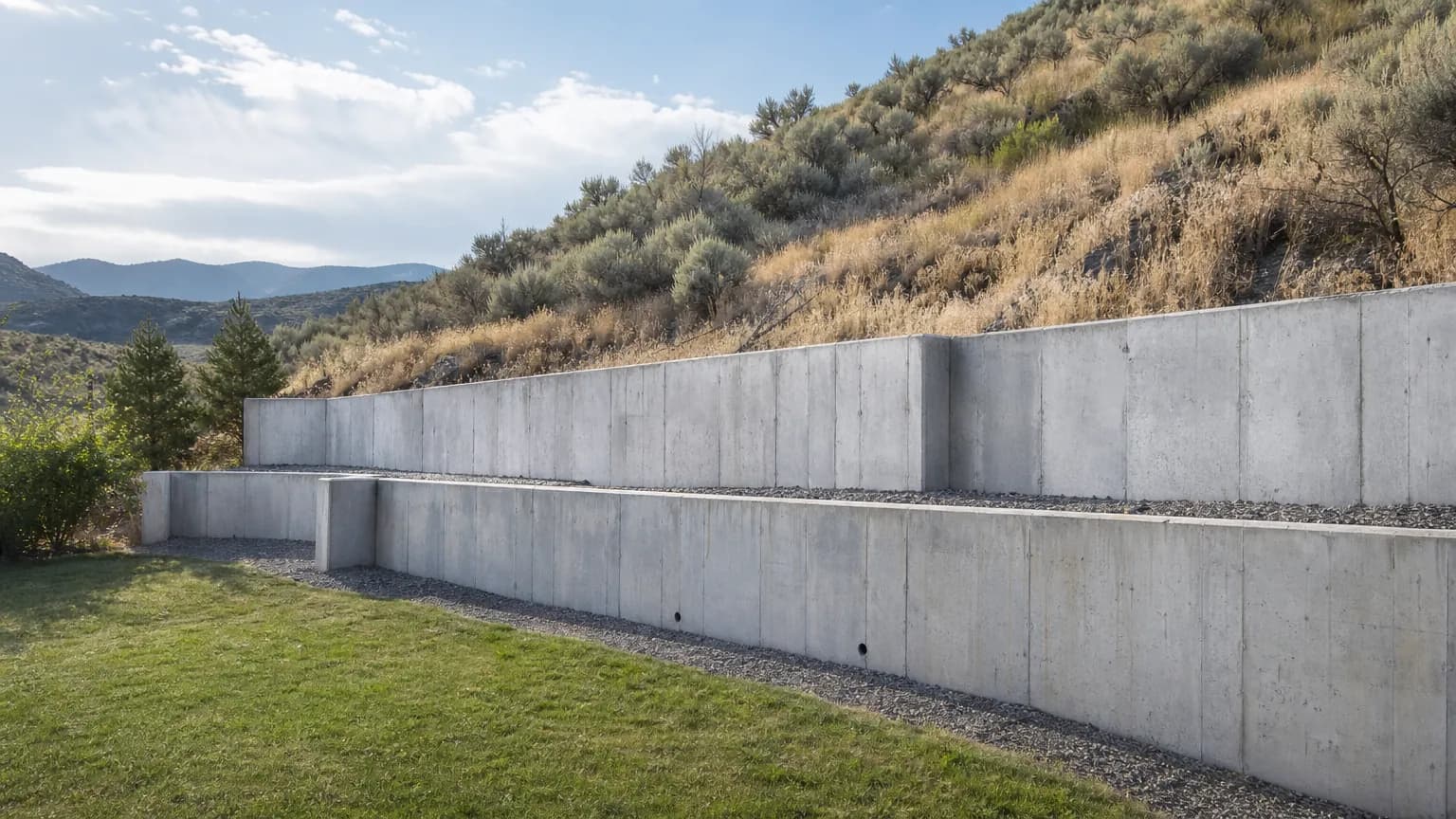
Poured concrete or segmental block
| Poured concrete | Segmental (interlocking) block | |
|---|---|---|
| Look | Smooth, board-formed or veneered | Textured block faces, many colors |
| Footing | Reinforced concrete footing | Compacted gravel leveling pad |
| Curves and steps | Possible, forming takes time | Easy to curve and step |
| Typical use | Driveway cuts, taller engineered walls, tight spaces | Garden terraces, backyard grade changes |
Search interest in the Boise area leans heavily toward block retaining walls, and for garden-height terraces they are often the practical choice. Taller walls and walls that hold up a driveway or a structure tend to be engineered either way.
Boise permit thresholds
Boise's homeowner guide requires a building permit for a retaining wall 4 feet high or more, measured from the bottom of the footing to the top of the wall, or for a 2-foot wall that holds back a slope or other surcharge (a driveway, a building, a steep bank). Those walls require engineering. Meridian's handout exempts walls not over 4 feet, footing to top. A 3-foot visible wall can measure over 4 feet once the buried footing is counted, so measure the way the code does.
Tiered walls, two shorter walls separated by a terrace, are a common way to manage a tall grade change, but walls close enough together can be treated as one surcharged wall. Ask the contractor and the city how your layout will be read.
Foothill lots and the hillside standards
Boise's hillside and foothills development standards apply where slopes exceed 15 percent, or where slope stability, springs and high groundwater, erosion, or expansive or collapsible soils are present. On steeper ground the code restricts development further. If your lot is in the foothills above the North End, near Table Rock or in Harris Ranch, ask whether wall work triggers a hillside review before you get attached to a design.
Drainage decides how long a wall lasts
Retaining walls fail from water more than weight. Saturated soil pushes much harder than dry soil, and in Boise it can also freeze. Standard practice is free-draining gravel behind the wall, a perforated drain at the base that discharges somewhere useful, and weep holes or open joints on block walls. On irrigated lots, sprinkler water from the yard above is a steady source; make sure the drain can handle it and that downspouts are not aimed behind the wall.
Cost
National cost guides put concrete retaining walls at about $20 to $60 per square foot of wall face installed. A 40-foot-long, 3-foot-tall wall is 120 square feet of face, roughly $2,400 to $7,200 at that range, before engineering, permits, excavation on a tight site, or hauling off soil. We did not find a reliable separate figure for block walls; local quotes are the way to compare them.
Back to the main guide: Boise concrete contractors.