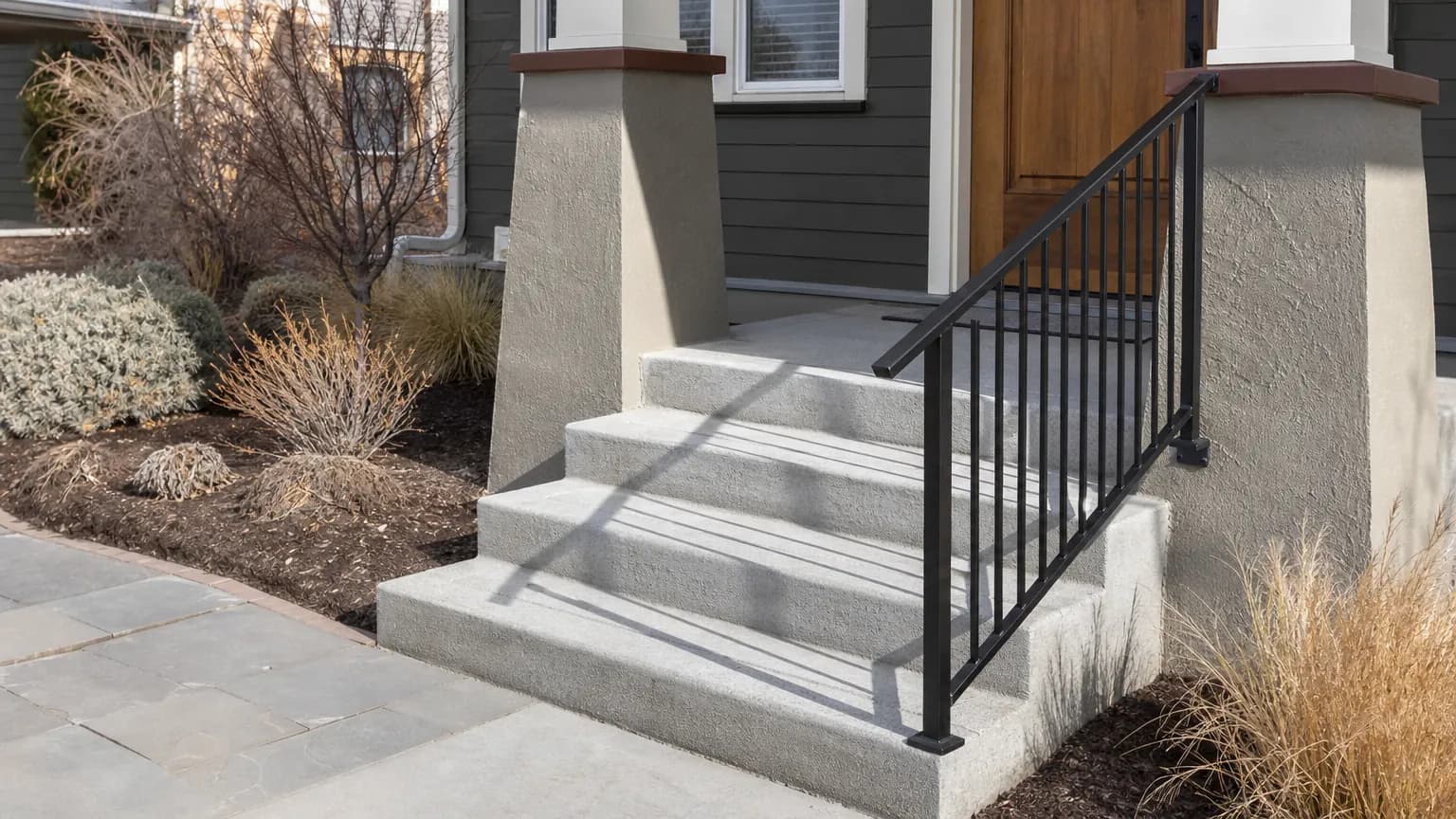
Poured in place or precast
Poured-in-place steps are formed on site to fit the door, the walk and the grade. Precast steps are cast at a plant in standard sizes and set with equipment. Precast is faster when a standard size fits; poured steps fit odd openings, wider stoops and curved approaches, and can match a stamped or exposed aggregate walkway.
Repair or replace?
| Condition | Usually |
|---|---|
| Chipped nosing, small spalls | Patch with a repair mortar; see concrete repair |
| Whole surface flaking after years of salt | Resurface if sound; see resurfacing |
| Steps pulled away from the house or tilted | Often replacement; sometimes leveling |
| Cracked through, loose pieces, rusting rebar showing | Replacement |
Steps that tilt toward the house send water against the foundation and siding, which is worth fixing even if the steps look fine.
Built for icy mornings
- A broom finish on the treads, running side to side, for grip.
- Treads pitched slightly forward so water and meltwater run off rather than pooling and freezing.
- Consistent riser heights. An uneven step is a trip hazard, especially in the dark.
- A sturdy handrail anchored into the concrete or the house.
- No deicers during the first winter. Sand works; salt can scale new concrete.
Building codes set rise, run and handrail rules for steps tied to a dwelling entrance, and taller stoops can need a permit. Ask the contractor and the building department; we did not verify thresholds for steps.
Older homes
In the North End, East End and older Bench neighborhoods, front steps can be decades old and sometimes sit on fill against a foundation that has moved. Replacement there may involve matching historic character. If your house is in a local historic district, ask the city whether exterior changes need review before you commit to a design.
Back to the main guide: Boise concrete contractors.