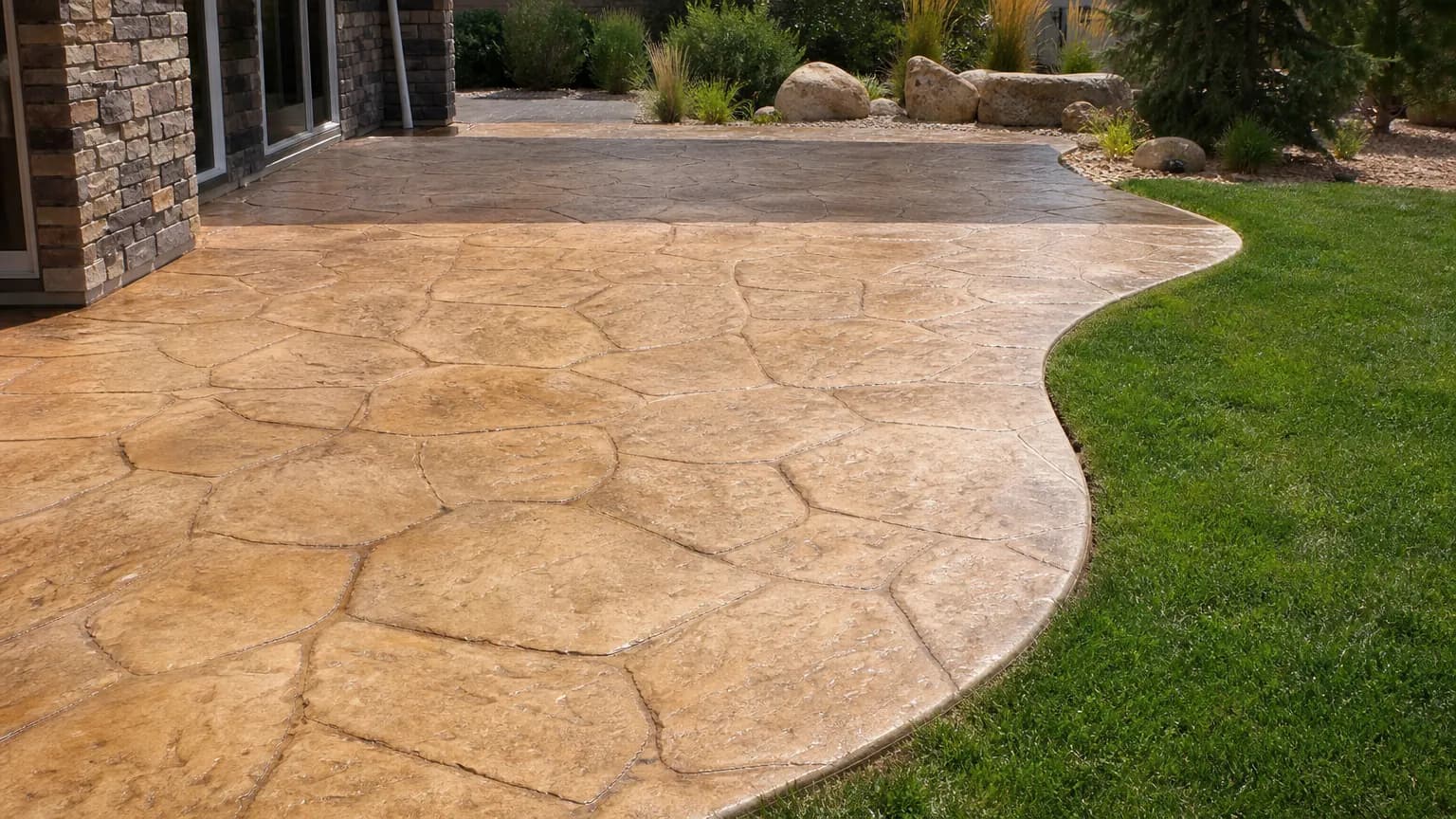
How stamped concrete is made
- The slab is formed and poured like any other, on the same compacted base, with the same joints.
- Color goes in: mixed into the whole batch (integral color), cast onto the wet surface as a color hardener, or both.
- A release agent, powder or liquid, is applied so the stamping mats don't stick. Powdered release in a darker shade stays in the low spots and gives the antiqued look.
- The crew presses textured mats into the surface while it is still plastic. Timing is everything: too early and the pattern slumps, too late and it won't take.
- After curing, the release is washed off and the surface is sealed.
Because the stamping window is short, crew size and weather on pour day matter. On a hot Boise July afternoon the window shrinks. Ask how many people will be on site and what time the truck is scheduled.
Patterns and colors that suit the valley
Random stone, ashlar slate, cobblestone, flagstone and wood-plank patterns are the common mats. Earth tones, sandstone, tan, buff and brown with darker antiquing, sit naturally against the sagebrush and basalt of the foothills, while grays pair with modern farmhouse exteriors. Seamless texture skins give a stone surface without grout lines.
Stamped borders around a broom-finish center are a cheaper way to get the look on a large patio or driveway. Stamped steps and porches are possible too; see concrete steps.
What stamped concrete costs
National cost guides put installed stamped concrete at about $12 to $25 per square foot, roughly double a plain slab, because of extra labor, color, release, sealer and the skill needed under time pressure. A 16 by 20 foot stamped patio is 320 square feet, roughly $3,840 to $8,000 at that range. Local contractors price by pattern, number of colors, border work, access and size; small jobs cost more per square foot.
Sealing, deicers and Boise winters
Sealer protects the color from UV fade and keeps water and salt out of the surface. Boise's long string of frost nights, more than 100 a year on average, makes that protection more important. Stamped surfaces are usually sealed with a film-forming acrylic that gives the wet look, and they need resealing every few years as it wears. A film sealer can get slippery when wet or frosted; ask about adding an anti-slip grit.
Keep deicing salts off stamped concrete entirely in its first winter, and sparingly after. Sand gives traction without the chemistry. If the surface starts flaking, see concrete resurfacing and concrete sealing.
Questions to put to a stamped concrete contractor
- Can I see a sample board or a finished job with the pattern and colors you're proposing?
- Integral color, color hardener or both? Which release color?
- Is the concrete air-entrained? What psi?
- Which sealer, how many coats, and when is the first reseal due?
- Where will the control joints run through the pattern?
Ask for the contractor's Idaho registration number too; any job over $2,000 requires registration with the Idaho Contractors Board.
Back to the main guide: Boise concrete contractors.