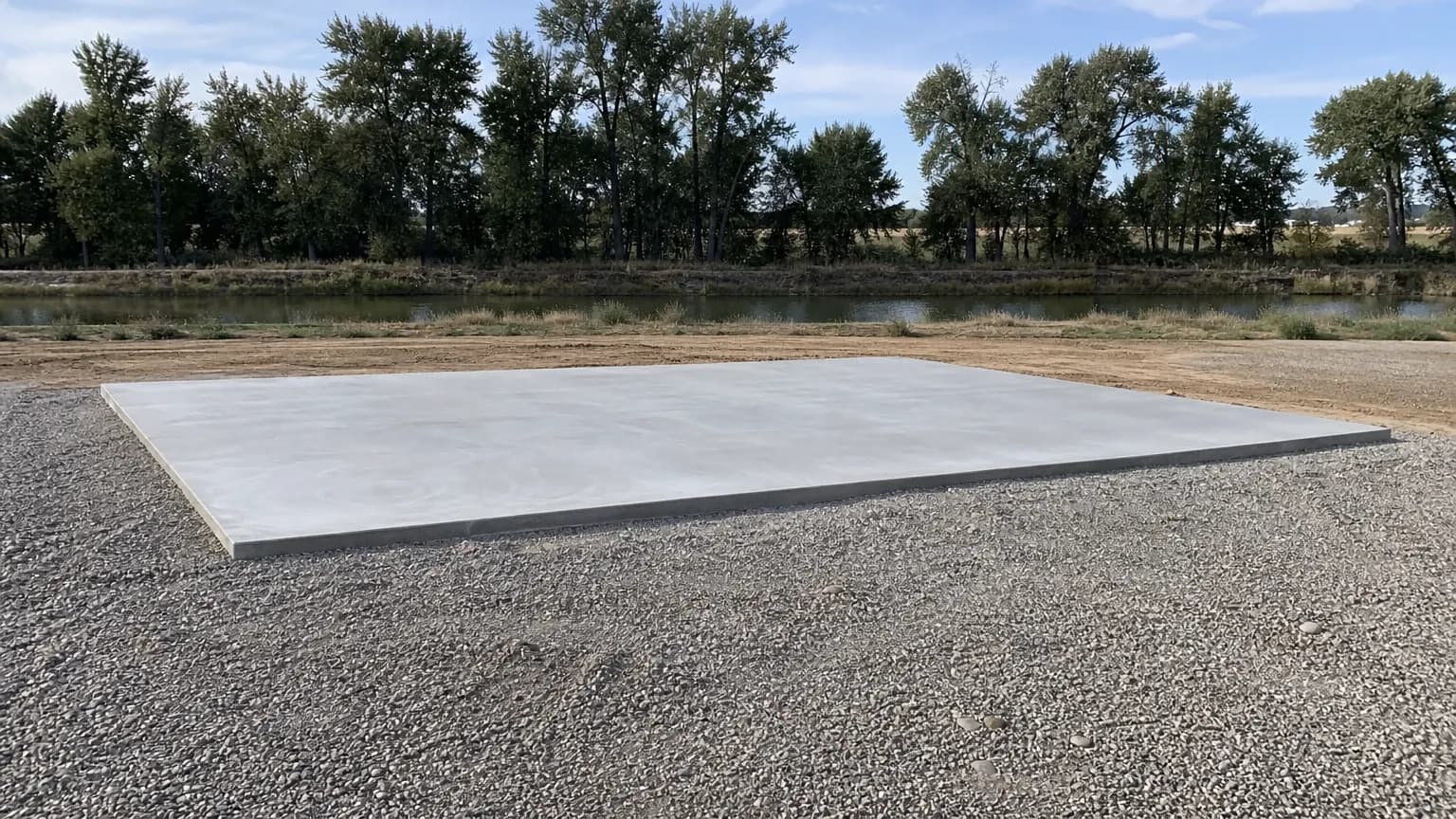
What the slab is for decides the spec
| Slab | What drives the design |
|---|---|
| Hot tub pad | Filled weight, flatness, power conduit |
| Shed pad | Size of shed, whether it is anchored, drainage around it |
| RV or trailer pad | Axle loads, turning tires, approach from the driveway |
| Shop or pole barn floor | Vehicle and equipment loads, edge footings or posts, doors and drains |
| Garage floor | Vehicles, slope to the door, see garage floors |
Give the contractor real numbers: the hot tub model, the shop's door sizes, the weight of the heaviest thing that will park on it. A slab specified for a riding mower is not a slab for a tractor.
When a slab becomes a foundation
A slab that only supports a hot tub or a parked trailer is flatwork. A slab that carries a building is different. Boise's code sets frost protection at 24 inches below finished grade for foundations that require it, and a city policy on small residential storage buildings says structures over 400 square feet (other than light-frame construction) and light-frame buildings over 600 square feet need a foundation to frost depth. That usually means footings or a thickened, deepened edge, and a building permit for the structure.
Pole barns are their own case: the posts sit on footings or piers, and the slab is often poured inside afterward. If you are planning a pole barn, see concrete foundations for footings and piers. Outside Boise, check with your city or county for its own size thresholds.
Base, reinforcement and joints
The base does most of the work. On caliche, the challenge is digging and drainage; on clay, it is moisture movement; on river-bottom sand and gravel, it is compaction and groundwater. Ask what base material and depth the contractor will use and how they will compact it. Rebar or wire mesh holds cracks tight; it does not stop cracks from forming. Joints do that job: about 24 to 36 times the thickness in inches apart, so 8 to 12 feet on a 4-inch slab, and wider spacing on thicker slabs.
What a slab costs
National cost guides put concrete slabs at about $4 to $12 per square foot installed. Basic thin pads sit at the bottom, reinforced and thickened shop floors at the top. Small pads cost more per square foot because mobilization, forming and the minimum truck charge are spread over fewer feet. The concrete slab cost page works through common sizes.
| Size | Area | At $4–$12 per sq ft |
|---|---|---|
| 8 × 8 hot tub pad | 64 sq ft | $256–$768 (small jobs often have a minimum) |
| 12 × 16 shed pad | 192 sq ft | $768–$2,304 |
| 12 × 40 RV pad | 480 sq ft | $1,920–$5,760 |
| 30 × 40 shop floor | 1,200 sq ft | $4,800–$14,400 |
Pouring on semi-rural lots
Shop slabs often go in on acreage in Kuna, Star, Middleton or Emmett, where the pour site can be a long way from the road. Access matters: a concrete truck needs firm ground and room to turn, and if it can't get close, the contractor may need a pump or buggies, which shows up on the quote. Irrigation ditches and laterals along property lines are common out there too; ask how the slab will sit relative to any ditch and where runoff goes.
Back to the main guide: Boise concrete contractors.