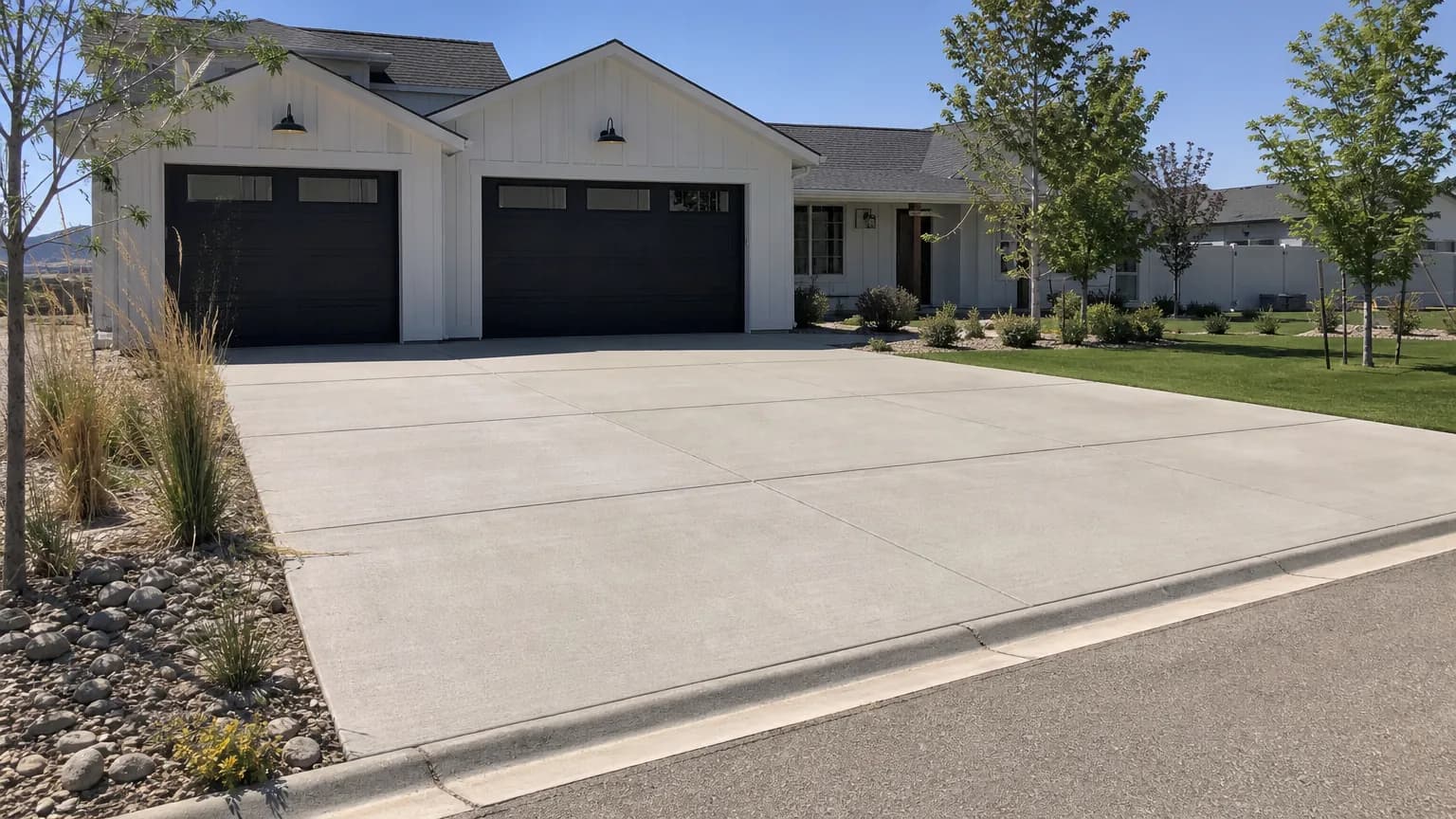
What a driveway job includes
The visible part is the last day. Before it, the contractor lays out the shape, digs out topsoil, builds and compacts a base, sets forms and plans the joint pattern. After the pour comes finishing, joint cutting and about a week of curing. The base and the curing are what you will notice in year ten, more than the finish you chose in week one.
Broom finish is standard: a light drag across the surface that gives tires and boots grip on frosty mornings. Alternatives include exposed aggregate, stamped concrete and integral color. If an old asphalt or concrete driveway has to come out first, see driveway replacement.
Slab thickness and a mix built for freeze-thaw
Four inches is the commonly cited minimum for a residential driveway that carries cars and light trucks. If a loaded pickup, a travel trailer or an RV will park on it, say so at the walk-through; that changes the thickness and base the contractor recommends, and some will thicken the edges where tires roll on and off.
The mix is the Boise-specific question. With most January nights below freezing, water in the surface pores freezes and expands over and over. The common recommendation for freeze-thaw climates is air-entrained concrete, about 4,000 psi, with a water-to-cement ratio of 0.45 or lower. Air entrainment puts microscopic bubbles in the paste that give freezing water room to expand. Ask whether the mix on your quote is air-entrained. If the answer is vague, ask again.
Base prep on caliche, clay or river gravel
Ground under Treasure Valley driveways varies a lot. Lime-cemented caliche has been documented on the Boise and Snake river terraces; it holds weight but can slow excavation and keep water from draining down. Bench neighborhoods tend toward heavier clay. Lots near the river can sit on silty sand and gravel with a high water table. Each calls for a different answer on depth of excavation, base material and compaction.
A contractor who has dug in your neighborhood can usually tell you what they expect to hit. Ask what base they plan, how thick, and how it will be compacted, and whether the price changes if they hit caliche that needs breaking up.
Joint layout
Concrete shrinks as it cures and moves with temperature, so it cracks. Control joints decide where. The rule of thumb is joints spaced 24 to 36 times the slab thickness in inches, so roughly 8 to 12 feet apart on a 4-inch driveway, cut at least a quarter of the way through. Panels close to square crack less than long skinny ones. Ask to see the joint plan on paper, especially where the driveway narrows or wraps around a corner of the garage.
Boise zoning: driveway width
Boise's homeowner guide says a driveway needs no building permit as long as it stays within the general exemption for flatwork (not more than 30 inches above grade), but it does need Planning and Zoning approval. The zoning code sets limits on driveways in the front setback: in many residential districts, a driveway there may not exceed 20 feet in width, a single- or two-family driveway must be at least 9 feet wide, and uncovered parking in front is capped at 20 feet or half the width of the façade, whichever is less.
That matters most for people who want to widen a driveway for a third car or a trailer. Call Planning and Zoning (208-608-7100) before you settle on a width. Meridian, Eagle, Nampa and the other cities have their own zoning codes; check with the city where the house sits.
The approach: ACHD in Ada County
The stretch between your property line and the street, including the curb cut and any public sidewalk, is public right-of-way. In Ada County that belongs to the Ada County Highway District. New or changed driveway approaches go through an ACHD Driveway Approach Request, which ACHD reviews in about a week and which stays valid for a year, followed by a right-of-way permit. ACHD requires the permit holder to be licensed and bonded for right-of-way work, and the approach has to meet ADA and ACHD specifications, including a sidewalk cross-slope of no more than 2 percent.
In Canyon County, the road may belong to a city (Nampa issues its own right-of-way permits) or to one of four highway districts. Ask the contractor who files the paperwork and confirm it before the forms go in.
Cost per square foot
Boise-specific pricing isn't published anywhere we could verify. National cost guides put these installed ranges on driveway work, and local contractors typically quote in or near them:
| Driveway | Typical national range |
|---|---|
| Plain broom-finish concrete | $6–$12 per sq ft |
| Stamped concrete | $12–$25 per sq ft |
| Exposed aggregate (added to base) | +$3–$8 per sq ft |
| Integral color (added) | +$2–$6 per sq ft |
| Tear-out of an old slab | $2–$6 per sq ft |
A 24 by 22 foot two-car driveway is 528 square feet: about $3,168 to $6,336 at the plain range before tear-out, approach work or upgrades. That is arithmetic, not a quote. The Boise concrete cost guide explains what pushes a number up or down.
The first winter
New concrete should go through its first winter with no deicers of any kind, including products sold as concrete-safe. Industry guidance is to use sand for traction instead, because the air voids in young concrete are still saturated and cannot relieve freezing pressure yet. After that, a penetrating sealer helps. See concrete sealing.
Back to the main guide: Boise concrete contractors.