
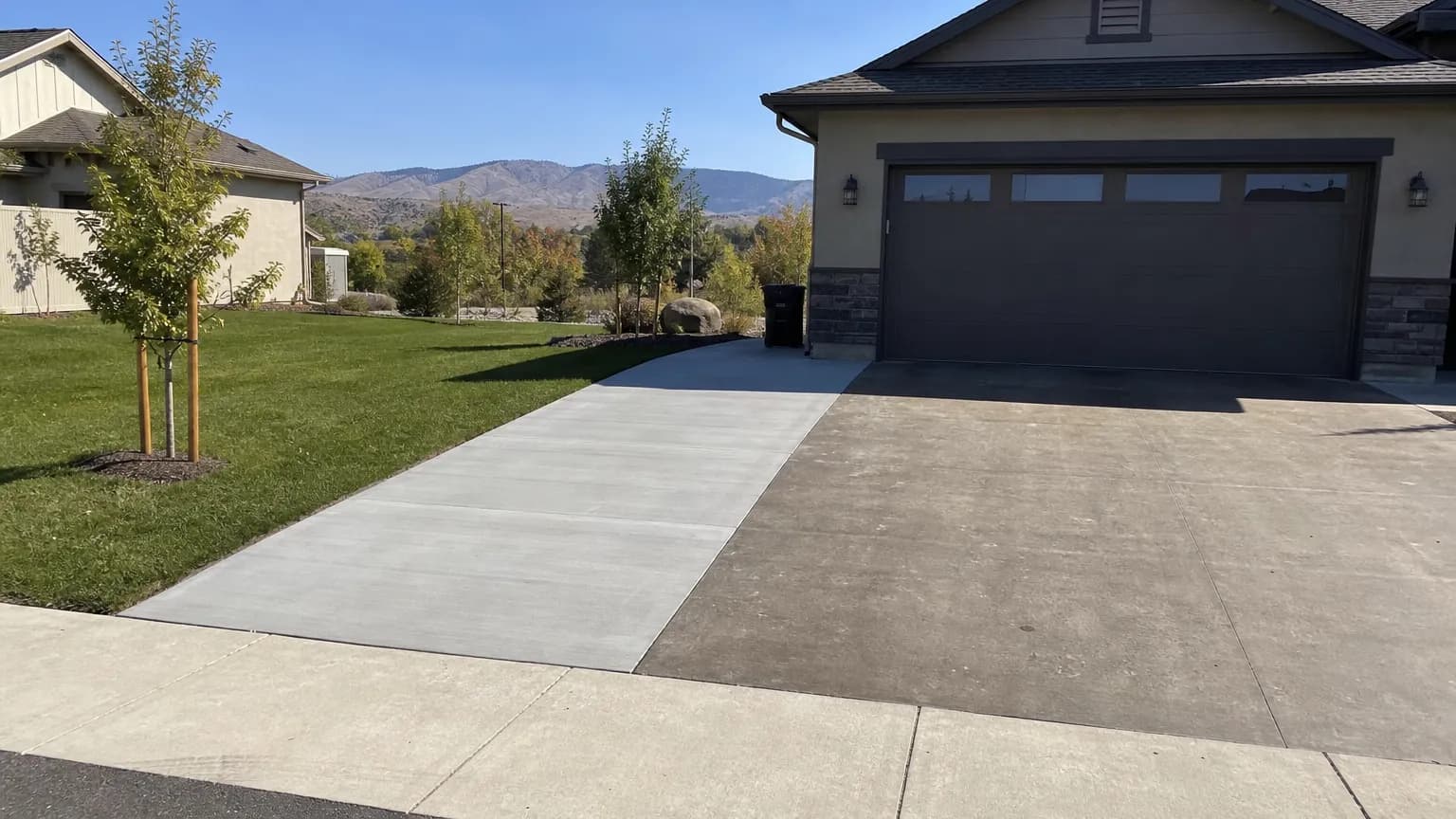
How wide you can go
This is the first question, before any forms go in. Boise's zoning code caps an individual driveway inside the front setback at 20 feet wide in many residential districts, sets a 9-foot minimum for single- and two-family driveways, and limits uncovered parking in front to 20 feet or 50 percent of the façade width, whichever is less. A two-car driveway widened to three cars across the front can run into that cap. The city's homeowner guide says a driveway needs no building permit when it sits no more than 30 inches above grade, but it does need Planning and Zoning approval (208-608-7100).
Extensions that run past the front setback, into a side yard or toward a back-yard pad, are a different case. The city allows gravel for parking outside the front and street-side setbacks, and wheel strips, pavers or other approved hard surfaces count as paving. For a trailer or camper spot, see RV pads.
The curb cut belongs to ACHD
Widening the driveway at the street means widening the approach, the apron and curb cut in the public right-of-way. In Ada County that is the Ada County Highway District's call: a Driveway Approach Request, roughly a one-week turnaround, approval good for a year, and a zone permit held by a contractor licensed and bonded to work in ACHD right-of-way. The approach has to meet ADA, ISPWC and ACHD specs, including a 2 percent maximum cross-slope where the sidewalk crosses it. In Canyon County the street owner is the city or one of four highway districts.
Tying new concrete to old
Where the extension meets the existing driveway, the common method is drilled-and-epoxied dowels: smooth half-inch bars set 12 to 18 inches apart and 6 to 8 inches into the old slab, so the two slabs stay level without locking together. Against the house foundation, a patio or a walk, a full-depth isolation joint of half-inch fiber board or foam goes in instead. If the old edge is broken or uneven, it is sawed back to a clean face first; see concrete cutting.
The new section should match the old in thickness (4 inches is the floor for cars) and use an air-entrained mix around 4,000 psi, the common recommendation in freeze-thaw country. Plan joints so they line up with the existing ones where possible.
What an extension costs
An extension is priced like new driveway work: national guides put plain broom-finish concrete driveways at about $6 to $12 per square foot installed. A 10 by 20 foot side pad is 200 square feet, so that range works out to roughly $1,200 to $2,400 before extras. Small jobs carry a minimum, so per-foot prices climb on short strips.
- Sod and soil removal, and haul-off
- Base gravel depth and compaction
- Doweling into the existing slab
- ACHD approach permit and curb cut, if the street end changes
- Moving sprinkler heads and lines in the way
For the whole driveway price picture, see the concrete cost guide.
Back to the main guide: Boise concrete contractors.