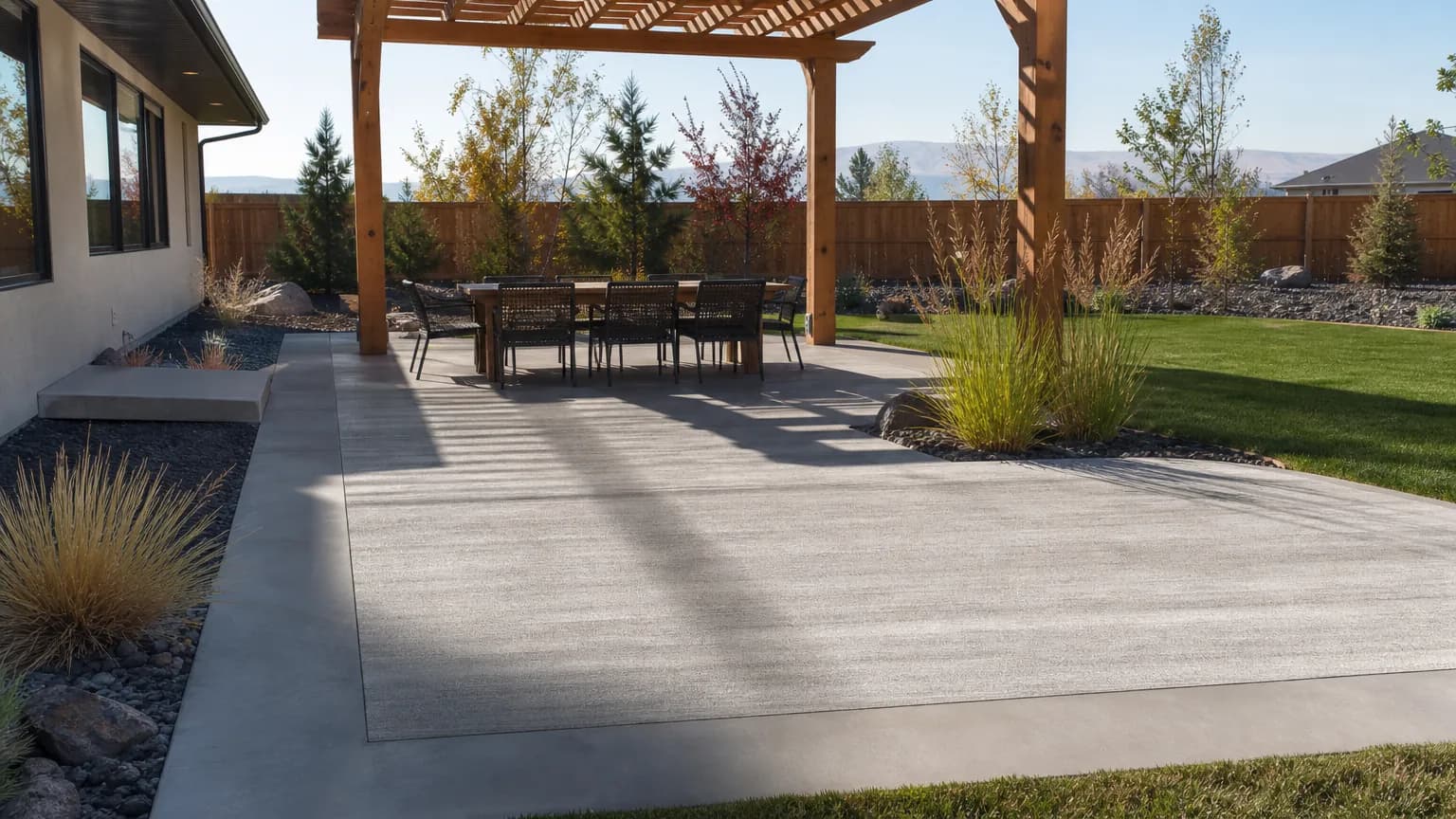
Finish options
| Finish | What it is | Good for |
|---|---|---|
| Broom | Light texture dragged across fresh concrete | Budget, grip, simple layouts |
| Troweled border + broom center | Smooth picture-frame edge | Clean look for little extra |
| Integral color | Pigment in the whole batch | Softer tone, less glare in summer sun |
| Stamped | Patterned mats pressed in | Stone or slate look, see stamped concrete |
| Exposed aggregate | Surface washed to show the stone | Grip and texture, see exposed aggregate |
Light gray concrete reflects heat, which helps on a west-facing patio in July, when Boise highs average about 92 to 93°F. It also shows dirt. A tan or buff integral color is a common middle ground.
Sizing a patio
Plan the furniture first. Set out the table with chairs pulled back, the grill with room around it and any lounge chairs, then measure around them. A walkway from the back door should not cut through the seating. It is cheaper to pour a larger slab once than to add on later, because a later extension needs its own forms, a joint against the old slab and usually a color mismatch.
National cost guides put patios at about $5 to $18 per square foot installed, from plain to custom. A 14 by 20 foot patio is 280 square feet, roughly $1,400 to $5,040 at that range. Small patios cost more per square foot because setup costs don't shrink with the slab.
Boise permits: the 12-inch rule
Boise's homeowner guide requires a building permit for a concrete patio more than 12 inches above grade. That is a lower threshold than the 30 inches that applies to walks and driveways, and it catches raised patios built up against a sloping yard or set level with a high back door. A ground-level patio generally needs no building permit. A patio that needs a retaining wall to hold it up may also trigger the wall rules; see retaining walls. Confirm with the city's building division at 208-608-7070. Other cities and Ada and Canyon counties publish their own rules.
Irrigation, downspouts and drainage
Most Treasure Valley subdivisions water lawns with pressurized irrigation from the canal system, which runs heavy through the summer. A patio that sits where sprinkler heads soak its edge, or where a downspout dumps next to it, is sitting on ground that stays wet. On clay that can mean swelling; on loose or silty soil, settling. Before the pour, move or redirect sprinkler heads and downspouts, and slope the slab away from the house so rain and snowmelt run off toward the yard, not the foundation.
Ask the contractor how much fall they will build in and where water will go. On a flat lot, a patio that drains toward a lawn or gravel strip is enough. On a sloped lot, drainage may be the biggest line item.
Hot tubs and pergolas
A filled hot tub is heavy. If one is going on the patio now or later, tell the contractor before the pour so the slab under it is thick and flat enough, and so there's a conduit for power. Pergolas and patio covers sit on footings, and covers can need their own permit; check with the city before you build one. See concrete slabs for pad sizing and concrete foundations for footings.
Before you sign
- Ask for the contractor's Idaho contractor registration number and look it up at dopl.idaho.gov.
- On a job over $2,000, expect the Idaho Code 45-525 disclosure about lien waivers, insurance and surety bonds before you sign.
- Get finish, thickness, base, joints, slope, sealer and cleanup in writing.
Back to the main guide: Boise concrete contractors.