
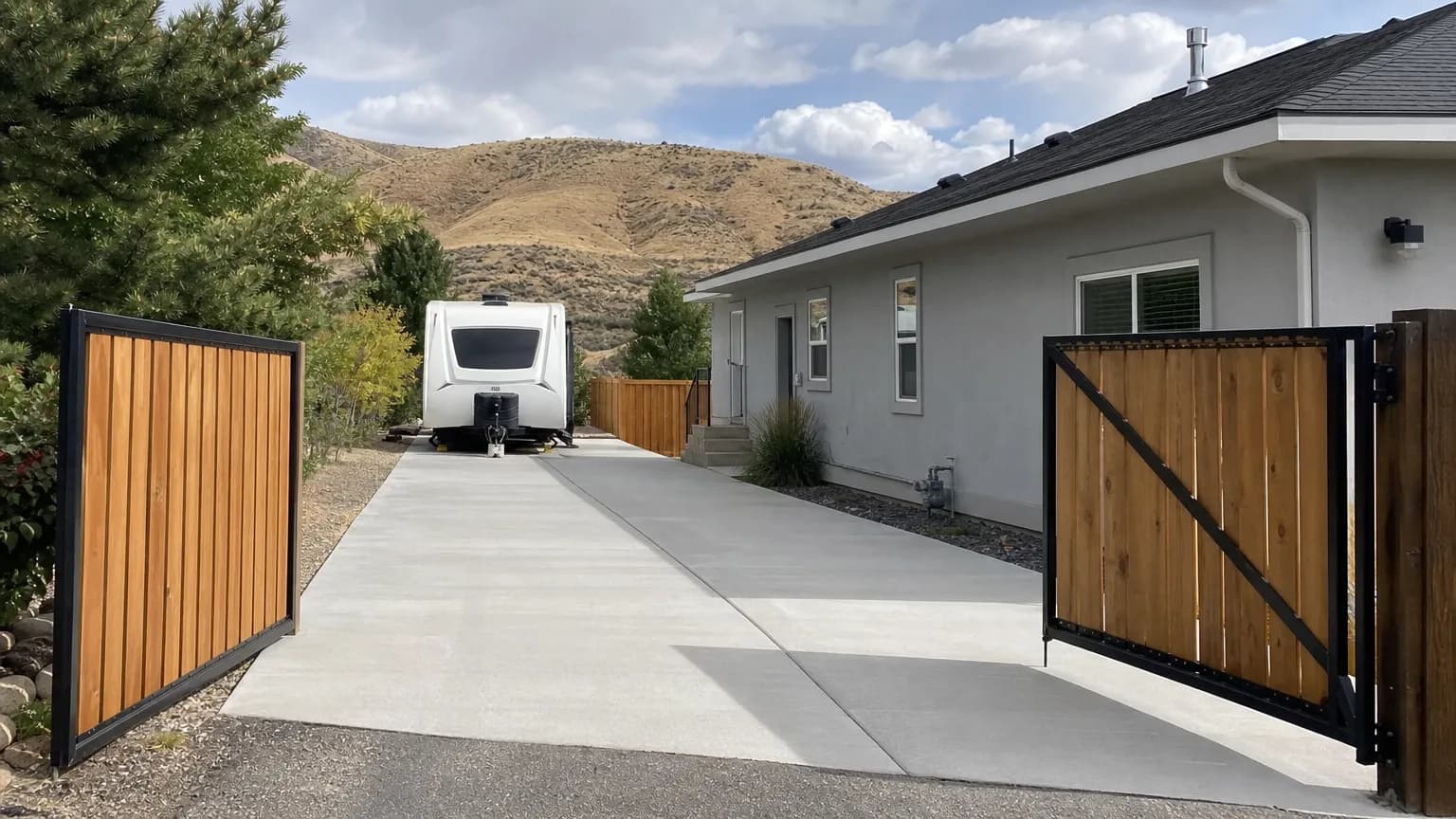
Size and thickness
Typical RV pads run 12 to 14 feet wide and 30 to 45 feet long, sized to the rig plus room to open doors and slide-outs. Measure the trailer or motorhome, add a few feet at each end, and check the turn in from the street.
| Rig | Common slab recommendation |
|---|---|
| Utility trailer, boat, small camper | Driveway-grade slab; 4 in is the floor for cars |
| Travel trailers, fifth wheels, most motorhomes | 6 in |
| Large Class A diesel pushers | 8 in |
Under the slab, one cost source recommends about 6 inches of compacted crushed stone and a 1 to 2 percent slope so water runs off rather than pooling under the tires. Caliche, the lime-cemented hardpan found on parts of the Boise and Snake river terraces, can slow that excavation; ask what the contractor expects to hit on your lot.
Where the zoning code lets an RV sit
The city's zoning code treats trailers, boats, campers and RVs not in daily use differently from cars. They may park on gravel, but they are prohibited from parking in the required setbacks, including the front and street-side yard setbacks. In practice that puts most pads in a side yard behind the front setback or in the back yard. Lot setbacks vary by zoning district, so check yours with Boise Planning and Zoning (208-608-7100) before the pad is laid out. Outside Boise, the rules are your city's or Ada or Canyon County's.
If the pad needs a new or wider curb cut, the approach belongs to the street owner: in Ada County that is the Ada County Highway District, through its Driveway Approach Request and a permit held by a contractor licensed and bonded for right-of-way work. See driveway extensions for widening an existing approach.
Gravel or concrete
Gravel is allowed for RV parking within city limits outside the setbacks, and it costs less up front. Concrete gives a flat, clean surface for leveling jacks and tires, and a pad can be poured to connect with a shop slab or driveway.
Access, gates and sprinklers
Side-yard pads are often tight. A ready-mix truck needs firm ground and room to reach the forms; where it cannot, a pump or wheelbarrows add cost. Gates may need to come off. Many Treasure Valley subdivisions water lawns with pressurized irrigation, and those lines can run right where a side-yard pad goes, so mark heads and valves before excavation and call Digline (811) at least two business days ahead.
What an RV pad costs
Concrete slabs run about $4 to $12 per square foot nationally, and RV pads sit toward the upper half because of the thickness. One concrete cost site lists installed RV pads at $1,800 to $7,200, with a 10 by 40 foot pad at $2,400 to $3,600 and a 12 by 45 foot pad at $3,200 to $4,900. Tear-out of old concrete or sod, an ACHD approach, pumping and extra rebar add to it. See the slab cost guide for how thickness and size change a quote.
Back to the main guide: Boise concrete contractors.