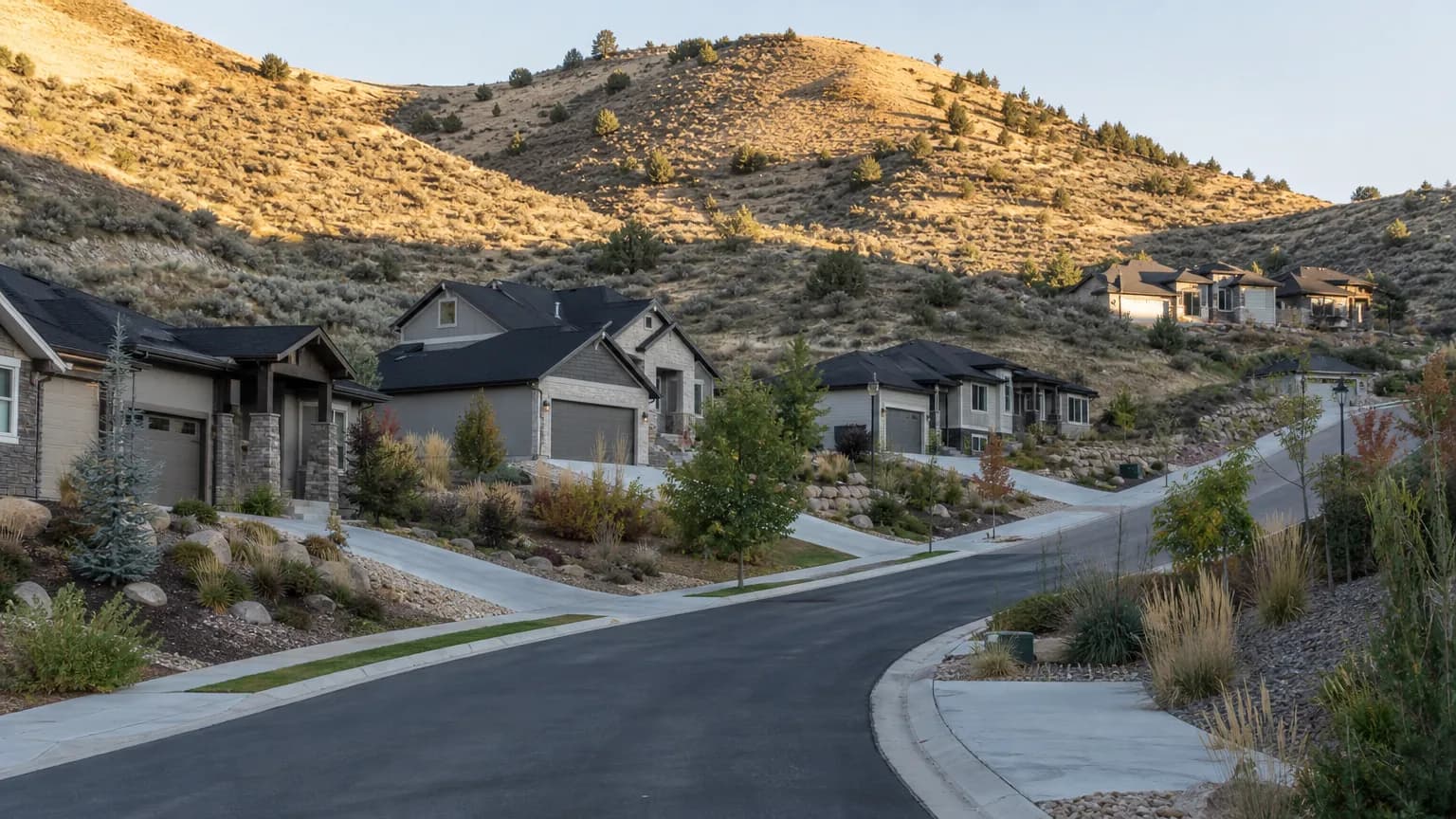
River bottoms and foothills
Eagle sits about 10 miles northwest of downtown Boise, with the Boise River running through it in more than one channel; Eagle Island State Park and the Eagle Fish Hatchery, which works on Snake River sockeye salmon conservation, sit along that river corridor. Near the river, ground tends toward silty sand and gravel, sometimes with groundwater close to the surface, which matters for footings and for how much base a slab needs.
North of town the land climbs into the foothills. Sloped lots there mean retaining walls, stepped patios and driveways with real grade. Boise's hillside standards don't apply inside Eagle city limits, but the same physics does: water runs downhill toward your slab, and drainage planning comes first.
What Eagle homeowners ask for
Eagle's newer, larger homes drive a lot of decorative work: stamped concrete patios, exposed aggregate driveways and walks, pool decks and landscape curbing. If an outdoor kitchen or hot tub is part of the plan, the slab under it should be planned for the load and the utilities before the pour.
Permits and the right-of-way
Public streets in Eagle belong to the Ada County Highway District. A new or modified driveway approach goes through an ACHD Driveway Approach Request and right-of-way permit, and ACHD requires the permit holder to be licensed and bonded for that work. Building-permit thresholds for walls and raised patios are set by the City of Eagle; we did not verify Eagle's specific numbers, so ask the city's building department before designing a wall near 4 feet or a raised patio. Some Eagle subdivisions also have HOA design rules for driveways and hardscape; check yours.
Getting quotes
Send the request with your subdivision or cross streets, the job, size and any slope. Contractors who work in Eagle follow up to look at the site. Before signing, check the contractor's Idaho registration at dopl.idaho.gov, and on a job over $2,000 expect the Idaho Code 45-525 disclosure.
Back to the main guide: Boise concrete contractors.