
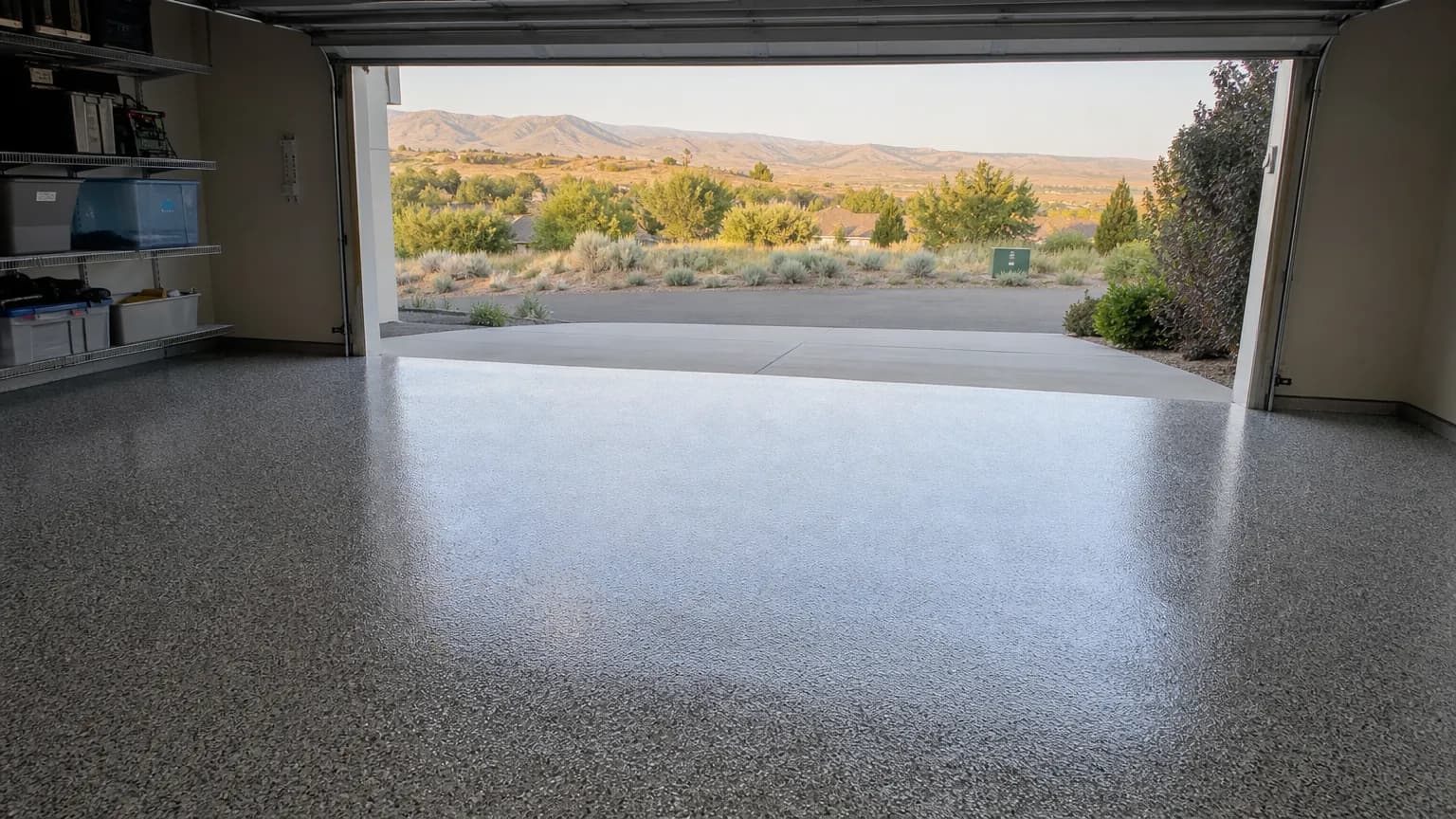
What a coating system is
A garage coating is not paint. A typical professional system is a base coat of epoxy, a broadcast of colored flake (or a metallic pigment for a swirled look), and a clear topcoat. Polyaspartic and polyurea coatings are a faster-curing alternative used as a full system or as the topcoat over epoxy. Ask each bidder to name every layer, its thickness and its cure time before you drive on it.
| Finish | What it looks like | Notes |
|---|---|---|
| Flake (chip) | Speckled color broadcast into the base coat | The common garage system |
| Metallic epoxy | Swirled, pearly depth | National guides put it at $5 to $12 per sq ft |
| Polyaspartic or polyurea | Clear or pigmented, flake or solid | Faster cure; $5 to $12 per sq ft in national guides |
Prep decides whether it sticks
Most coating failures are prep failures. The slab is diamond-ground to open the surface to a concrete surface profile, rated on the ICRI CSP scale from 1 (nearly smooth) to 10 (heavily roughened). Garage coatings typically target CSP 2 to 3. Oil spots, old sealer and paint have to come off, and cracks and spalls get filled before the base coat.
Grinding matters in particular for hot tire pickup: tires coming in hot from the road soften a weak coating, then pull it off the floor as they cool. Mechanical grinding, a polyaspartic topcoat and a full cure before parking are the usual defenses.
Moisture and new slabs
Concrete keeps releasing water vapor long after it hardens. Coat too early and that vapor gets trapped under the resin, which shows up as bubbles and peeling. Standard specifications call for new concrete to cure at least 28 days before a resinous coating, and the real number depends on the mix, temperature and humidity.
Two tests give an answer instead of a guess. ASTM F2170 measures relative humidity inside the slab; most resinous flooring makers accept readings under 80%. ASTM F1869, the calcium chloride test, measures vapor coming off the surface; most makers want under 3 lb per 1,000 sq ft per 24 hours. If you are pouring a new garage floor and planning a coating, tell the concrete contractor up front so the finish suits a coating.
Winter salt and slush
Idaho road crews use salt brine and magnesium chloride among their deicers, and that slush rides into the garage on every car all winter. On bare concrete, the cycle of salt water soaking in and freezing scales the surface. A sound coating keeps the brine on top where it can be squeegeed out.
What a coated floor costs
National cost guides put professionally installed epoxy at about $3 to $12 per square foot. This Old House prices a standard two-car garage of about 360 sq ft at $1,080 to $4,320. HomeGuide lists polyaspartic and polyurea systems at about $5 to $12 per square foot, or $2,000 to $6,900 for a two-car garage. Local quotes depend on garage size, how much grinding and crack repair the slab needs, and the system chosen.
- Is diamond grinding included, and to what profile?
- Will you test moisture first, and with which method?
- Which layers, which products, and how thick is each coat?
- How long before foot traffic, and before parking a car?
- What is excluded: crack repair, stem walls, steps into the house?
Back to the main guide: Boise concrete contractors.